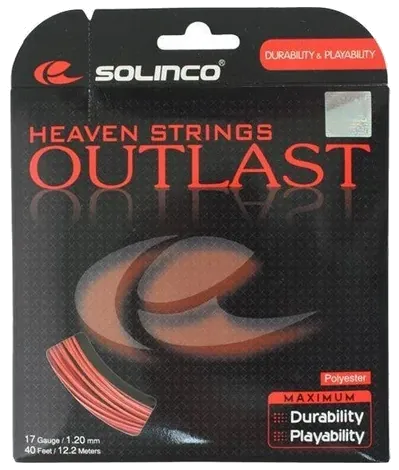
$9.50Buy it now
Solinco
Outlast 17
Lab measurements for Solinco Outlast 17, ranked against all 791 strings in the database. Every figure below is a testing-machine result at a fixed reference tension, not a playtest opinion.
Measured values
Stiffness
183lb/in
lower = softer, kinder on the arm
Tension loss
50%
lower = stays where you strung it
Energy return
84%
higher = livelier, more free power
Spin potential
5.5
higher = more spin off the string bed
Ball bite
0.406COF
higher = grabs the ball harder
String friction
0.074COF
lower = strings slide and snap back
How it ranks against all 791 strings
Stiffer than 49% of strings tested.
Sheds more tension than 89% of strings tested.
Livelier than 13% of strings tested.
More spin potential than 69% of strings tested.
Grips the ball harder than 27% of strings tested.
More string-on-string friction than 12% of strings tested.
Like Outlast 17, but…
Almost nobody looks a string up out of curiosity. You are here because something about your current setup is wrong. Each list below keeps the rest of this string's profile as close as it can while moving decisively on the one thing you picked, so these are swaps rather than merely different strings.
SofterKinder on the arm
FirmerMore control, less launch
More spinBites and snaps back harder
More powerHands more back to the ball
Less powerLower launch, more control
Holds tensionStays where you strung it
What Outlast 17 is actually good for
Its standing on each of the site's rankings, out of every measured string in the database. Same arithmetic as the finder, not a separate opinion.
How long it lasts, and how far it stretches
Playable life
~13hours
Estimated from tension loss, on a scale running from 40 hours for the best-holding strings in the database down to 10 for the worst. At four hours a week that is about 3 weeks.
Estimated, not measured. This estimates when the bed goes dead, not when the string snaps. If you break strings before you notice them going dull, you are a breaker, and thickness and material matter far more to you than tension hold does.
Elongation under load
How far the string stretches when tensioned to a given load. A string that elongates more absorbs more of the impact itself and feels softer; one that barely moves passes more of it on to the frame and the arm.
Measured at every tension and swing speed
The figures at the top of this page come from one test condition: 51 lb at fast swing speed. There are nine in total, and all of them are below. Tension moves the bed more than the choice between two similar strings does, so this is the table that actually answers "what will it feel like for me".
Bed stiffness against tension · Fast swing
Measured at three tensions, with the fitted response drawn across the whole stringable range. The line does not pass through the origin: this bed carries about 36 lb/in that does not come from tension at all, and gains roughly 2.9 lb/in for every extra pound you string it at.
What that means
Stringing Outlast 17 at 30 lb gives a bed of about 122 lb/in; at 70 lb it is about 237 lb/in. That range is wider than the gap between most pairs of strings on this site, which is the single most useful thing this page can tell you.
Stiffness lb/in lower = softer, kinder on the arm
| Strung at | Slow swing | Medium swing | Fast swing |
|---|---|---|---|
| 40 lb 18.1 kg | 190 | 164 | 151 |
| 51 lb 23.1 kg | 242 | 205 | 183 |
| 62 lb 28.1 kg | 263 | 234 | 214 |
Tension loss % lower = stays where you strung it
| Strung at | Slow swing | Medium swing | Fast swing |
|---|---|---|---|
| 40 lb 18.1 kg | 61 | 61 | 61 |
| 51 lb 23.1 kg | 50 | 50 | 50 |
| 62 lb 28.1 kg | 43 | 43 | 43 |
Energy return % higher = livelier, more free power
| Strung at | Slow swing | Medium swing | Fast swing |
|---|---|---|---|
| 40 lb 18.1 kg | 89 | 83 | 77 |
| 51 lb 23.1 kg | 95 | 91 | 84 |
| 62 lb 28.1 kg | 97 | 94 | 89 |
The highlighted cell is the condition every other figure on this site is quoted at.
What else the machine recorded
Further measurements from the same test, given at the reference condition of 51 lb, fast swing.
Dwell time
36.9ms
How long the ball stays on the string bed. Longer dwell is the physical basis of what players call hold or pocketing.
Bed deflection
33.0mm
How far the string bed moves at impact. More deflection means the bed is doing more of the work of stopping the ball.
Peak force
31lb
The highest force perpendicular to the string bed during impact. The spike the frame and the arm actually receive.
Tension at impact
25.7lb
What the bed is actually pulled to by the time the ball arrives, after it has settled. Always lower than the tension it was strung at.
Loss: settling
8.7lb
Tension lost simply from being strung and left alone, before a ball is hit.
Loss: bedding in
16.3lb
Tension lost while the bed settles over its first impacts.
Loss: impact
0.6lb
Tension lost to the impact itself. Frequently negative, because a bed often gains tension across an impact rather than losing it.
Loss: total
25.6lb
The three losses above added together, in pounds.
Strings that play like this
Closest matches across stiffness, tension loss, energy return and spin potential.
Head to head: Outlast 17 vs Hepta-Twist 17 · Outlast 17 vs Poly Power Pro 16L (1.25) · Outlast 17 vs Polylon Comfort 16
More from Solinco
- Barb Wire 16 gauge 16
- Barb Wire 16L (1.25) gauge 16L
- Barb Wire 17 (1.20) gauge 17
- Confidential 16 (1.30) gauge 16
- Confidential Soft 16L (1.25) gauge 16L
- Hyper-G-Soft 16L (1.25) gauge 16L
- Hyper-G 16 gauge 16
- Hyper-G 16 Round (1.30) gauge 16
- Hyper-G 16L (1.25) gauge 16L
- Hyper-G 17 (1.20) gauge 17
- Hyper-G 18 (1.15) gauge 18
- Mach 10 16 (1.30) gauge 16
What these numbers mean
Stiffness · lb/in
How much the string bed resists deflection. Higher plays firmer and more controlled; lower plays softer and easier on the arm.
Tension loss · %
Share of the reference tension the string sheds under a fixed test protocol. Lower means the bed stays where you strung it for longer.
Energy return · %
Share of impact energy handed back to the ball. Higher plays livelier and more powerful.
Spin potential
Ball friction divided by string-on-string friction. Higher means better bite with a cleaner snapback, so more spin.
Ball bite · COF
String-on-ball friction. Higher grabs the ball harder through the brush.
String friction · COF
String-on-string friction. Lower lets the mains slide and snap back into place after impact.
Compare Outlast 17 against 791 strings Switching from this? Convert your tension Use it in a hybrid Find it on the map Find the right string for me